June 13 @ 11:30 am - June 14 @ 5:00 pm MDT
May 28, 2024 | Virtual, Pre Event Keynote: Thomas Keurner | Will provide background information from a different country perspective.
June 5-6, 2024 | Virtual, Pre Event Drop-Ins: Daniel Mittleman | Will facilitate a comprehensive dialogue regarding the structure and objectives of the upcoming in-person event.
June 13-14, 2024 | In-Person, Denver, CO
This visioning event will convene top researchers from various sectors to consider the theme of Strategic Engineering for Next-Generation Wireless Competitiveness. It will be transdisciplinary with respect to engineering disciplines, sectors, and stakeholders interested in wireless technologies, including researchers, industry professionals, nonprofits, and venture capital firms.
The ERVA visioning event is focused on identifying and articulating the near and long term strategic focus for engineering research that will place the United States in a competitive position world wide.
High level agenda:
Day 1 (11:30 a.m. - 5:00 p.m. MT)
-Lunch keynote
-Directed ideation session on various topics
Day 2 (8:30 a.m. - 5 p.m. MT)
-Panel discussion on why engineering research is needed in this field
-Directed ideation session on various topics
-Lunch keynote
-Directed ideation session on various topics
June 5 @ 8:00 am - June 6 @ 2:00 pm EDT
May 23, 2024 | Virtual, Pre Event Drop-In: Michelle Oyen | Will facilitate a comprehensive dialogue regarding the structure and objectives of the upcoming in-person event.
June 5-6, 2024 | In-Person, Columbus, OH
This visioning event will convene top researchers from various sectors to consider the theme of Transforming Women's Health Outcomes through Engineering. It will be transdisciplinary with respect to engineering disciplines, sectors, and stakeholders interested in women's health technologies, including researchers, industry professionals, nonprofits, and venture capital firms.
The ERVA visioning event is focused on identifying and articulating the near and long term strategic focus for engineering research that will place the United States in a competitive position world wide.
High level agenda:
Day 1 (8:00 a.m. - 5:00 p.m. ET)
-Panel discussion on why engineering research is needed in this field
-Directed foresight and ideation exercises
-Lunch keynote
-Directed ideation session on various topics, Ages and Stages of a woman's life: 0-15 (in utero to puberty), 15-45 (reproductive years - related to pregnancy), 15-45 (reproductive years - not related to pregnancy), 45- (pre peri and post menopausal)
Day 2 (8:00 a.m. - 2 p.m. ET)
-Directed ideation session on various topics, Technology fields: AI/Imaging, Computer Modeling, Diagnostic Technologies/Devices, Tissue Engineering/Microfluidics
-Lunch: Table Topics
-Closing comments
March 19 @ 8:00 am - March 20 @ 1:00 pm
March 5-7, 2024 | Virtual, Pre Event Drop-Ins: Saikat Guha, Brian Gaucher | Will facilitate a comprehensive dialogue regarding the structure and objectives of the upcoming in-person event.
March 19-20, 2024 | In-Person, Tucson, AZ
This visioning event will convene top researchers from various sectors to consider the theme of Quantum-Enabled Technologies. It will be transdisciplinary with respect to engineering disciplines, sectors, and stakeholders interested in quantum-enabled technologies, including researchers, industry professionals, nonprofits, and venture capital firms.
The goal of ERVA's visioning events is to create roadmaps for near and long-term engineering research opportunities with the highest potential for positive societal impact.
High level agenda:
Day 1 (8:00 a.m. - 5:00 p.m.)
-Panel discussion on why engineering research is needed in these 4 fields
-Directed ideation session on various topics: Quantum and Biology, Quantum and Materials, Quantum and AI, Quantum and Computing
-Lunch keynote with Oliver Dial from IBM
-Directed ideation session on various topics: Quantum and Biology, Quantum and Materials, Quantum and AI, Quantum and Computing
Day 2 (7:30 a.m. - 1 p.m.)
-Directed ideation session on various topics: Quantum and Biology, Quantum and Materials, Quantum and AI, Quantum and Computing
-Lunch keynote with Steve Walsh from The University of New Mexico
February 6 @ 8:30 am - February 7 @ 2:00 pm
January 23-February 1, 2024 | Virtual, Pre event speakers: Kenneth Phillips, Joshua (Scotch) McClure, James J. Collins | Will provide background information from different sectors.
February 6-7, 2024 | In-Person, Houston, TX.
This visioning event will convene top researchers from various sectors to consider the theme of Engineering Solutions to Combat Antimicrobial Resistance. It will be transdisciplinary with respect to engineering disciplines, sectors, and stakeholders interested in combating antimicrobial resistance, including clinicians, medical faculty, nonprofits, and venture capital firms.
The goal of ERVA's visioning events is to create roadmaps for near and long-term engineering research opportunities with the highest potential for positive societal impact.
High level agenda:
Day 1 (8:30 - 5:00 p.m.)
-Panel discussion on the role of engineering from a clinician's perspective
-Ideation session using foresight and design thinking techniques
-Lunch keynote with Diane Flayhart from BD (Becton, Dickinson and Co.)
-Directed ideation session on various topics: Engineering the microbiome, AI to accelerate antibiotic discovery, Translational medicine and engineering, Data collection
Day 2 (8:30 - 2 p.m.)
- Directed ideation session on various topics: Early diagnostics, Engineering to prevent disease spread, Antimicrobial biomaterials, Immunoengineering
-Lunch keynote with Kevin Outterson from Boston University & CARB-X
11•07•2023 @ 8:30 am - 11•08•2023 @ 2:00 pm
This visioning event will convene top researchers from various sectors to consider the theme of Strategic Thinking for Engineering Research in the Era of Artificial Intelligence.
November 7-8 | In-Person, Atlanta, GA
The goal of ERVA visioning events is to identify specific areas that are nascent or require additional exploration with the potential for the greatest return on investment.
ERVA is holding this event to envision the future of artificial intelligence and identify the emerging research opportunities where engineering can lead and accelerate our global competitiveness. This is an exceptional opportunity for the engineering community to come together to discussed the future of the research funding landscape.
Academic and industrial researchers have achieved very impressive breakthroughs in artificial intelligence (AI) in recent years. Large-scale investments in AI from governments and the private sector worldwide will likely fuel breakthrough achievements, new technologies, and new tools that potentially transform industries, businesses, governments, and educational institutions.
Engineering subfields are actively engaged in these developments. Robotics, automation, and control theory are leading the development of AI with autonomy and safety guarantees. Information theory and signal processing are also making important contributions. At the same, other fields such as civil engineering, environmental engineering, mechanical engineering, materials science, etc., are taking advantage of powerful new machine learning and big data technologies.
In view of the rapid progress in AI, it is critically important that engineering leaders in academic, industry, and government organizations are leaning forward and positioning engineering research community to play leadership roles in (1) the development of new AI technologies suited for engineering applications and imperatives, and (2) in the use of the most powerful AI techniques to advance engineering research fields.
The proposed ERVA event is aimed at developing key insights and major opportunities for academic, industry, and government organizations by answering the following questions:
- What are the major opportunities for engineering to lead advances in AI?
- What new questions can be formulated and feasibly answered to dramatically move engineering research to greater successes?
- What can engineering leaders do to ensure their organizations will thrive and meet their missions in the coming era of AI?
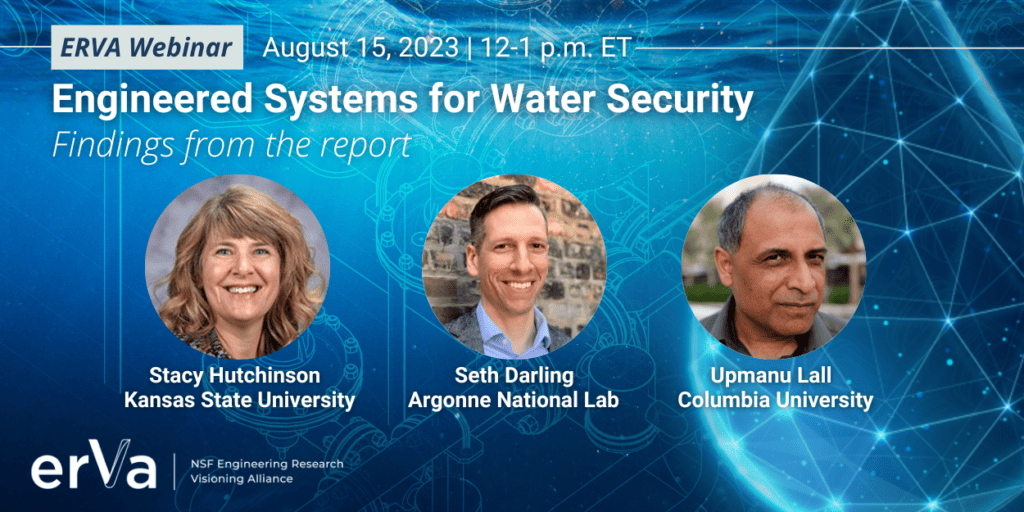
08•15•2023 @ 12:00 pm - 1:00 pm
Join ERVA and our Engineered Systems for Water Security visioning event chair for a webinar to discuss the findings of the recently released report.
The Engineering Research Visioning Alliance will host a webinar August 15, 2023 at 12 p.m. EDT, to discuss the findings of ERVA's report, Engineered Systems for Water Security. The event will feature Stacy Hutchinson, associate dean for research and graduate programs, Kansas State University; Seth Darling, chief science & technology officer for advanced energy technologies, Argonne National Laboratory; and Upmanu Lall, director of the Columbia Water Center and the Alan and Carol Silberstein Professor of Engineering at Columbia University.
This webinar will discuss the key research directions identified as a result of this visioning event and subsequent report.
This is an informational webinar with an opportunity for Q&A with the speakers at the conclusion of the panel discussion. Participation is welcome and encouraged. This webinar is free to attend, however registration is required.
07•25•2023 @ 8:30 am - 07•26•2023 @ 2:00 pm
The goal of ERVA Visioning Events is to identify specific areas that are nascent or require additional exploration with the potential for the greatest return on investment. Accordingly, we seek multi-disciplinary researchers who can help ERVA identify less-explored, basic and use-inspired lines of research ripe for engineering community pursuit.
ERVA invites you to participate in an event to envision the future of U.S. manufacturing and identify the emerging research opportunities where engineering can lead and accelerate our global competitiveness. This is an exceptional opportunity for your voice to be heard and influence the future engineering research funding landscape.
In-Person Visioning Event: Engineering Materials for a Sustainable Future
There is an urgent need to bring breakthrough materials research and development to the forefront of current sustainability efforts. Recent government action in the U.S. and globally has galvanized industries to pursue zero-carbon status. Corporate investors are also increasingly voicing interest in the development of sustainable materials solutions to enable a circular economy. This visioning workshop will unite researchers, industry leaders, policymakers, and investors to articulate materials engineering research priorities. This visioning event takes a holistic approach to discussing sustainable materials from the design stage, through scale-up and manufacturing, to the end-of-use scenarios for three key industries: chemical manufacturing, construction, and single-use consumer products.
Chemical manufacturing comprises ~40% of the GDP and is critical to creating fuel, fertilizers, plastics, pharmaceuticals, and many other necessary compounds. Yet, most catalytic reactions generally operate at high temperatures by burning petroleum fuels, generating significant greenhouse gas emissions and undesirable byproduct formation. Achieving precision chemistry, where reactions are simultaneously high-yield, product selective, and free from greenhouse-gas emissions, will be critical for a sustainable future. In parallel, the materials used in construction, such as steelmaking globally, account for ~3.8% of the GDP and ~8% of CO2 emissions, while concrete and cement account for an additional 8% of global CO2 emissions. While they are low-cost to produce, they are not easily recyclable. Balancing cost and performance while decarbonizing the processes to make construction materials is essential to achieve a zero-carbon future.
Finally, polymer chemistry provides us with cheap, durable, and customizable multilayer materials for a variety of single-use consumer product packaging; yet these attributes have given rise to massive waste accumulation and catastrophic greenhouse gas emissions. Biobased, compostable alternatives to traditional plastics rarely have equivalent functionality to their petroleum-based counterparts. Furthermore, energy-efficiency recycling methods for mixed materials waste streams remain an obstacle. In each of these industries, new materials utilizing renewable energy, renewable feedstocks, state-of-the-art chemistry, physics, synthetic biology, and artificial intelligence are required to enable net-zero or negative greenhouse gas emissions, increased recyclability/composability, and progress towards fully circular materials economy.
Sustainable Material Design
Sustainable material design refers to the development of materials and products that minimize the negative impact on the environment and human health. The use of sustainable materials in design is becoming increasingly important as we face challenges such as climate change, resource depletion, and pollution. Sustainable materials can also be designed to have a longer lifespan, reducing the need for replacement, and minimizing waste. Overall, sustainable material design is an essential component of creating a more sustainable future, and designers have a crucial role to play in developing innovative solutions to environmental and social challenges.
Manufacturing & Scale-Up of Sustainable Materials
Scaling-up sustainable material manufacturing involves increasing production to meet demand while maintaining these sustainable practices. To scale up sustainable material manufacturing, companies can invest in research and development to improve the efficiency and effectiveness of sustainable production methods. This can include finding new ways to recycle and reuse materials, developing more sustainable supply chains, and optimizing production processes to minimize waste and energy use. Sustainable material manufacturing also requires collaboration and partnerships across industries and sectors. This can include working with suppliers and customers to promote sustainable practices and educate consumers about the importance of sustainable materials. Overall, scaling up sustainable material manufacturing is essential for creating a more sustainable future. By adopting sustainable practices and investing in research and development, companies can produce materials and products that meet growing demand while minimizing the negative impact on the environment and human health.
Sustainable Material End-of-Use and Reuse
Sustainable materials end-of-use processes and reuse refer to the handling and disposal of materials and products at the end of their useful life in a way that minimizes waste and maximizes their value. Sustainable materials end-of-use processes are an essential component of the circular economy, where materials are kept in use for as long as possible. To promote the reuse of materials, companies can design products with end-of-use in mind. This can include using materials that are easily recyclable or designing products that can be easily disassembled and repurposed. Overall, sustainable materials end-of-use processes and reuse are crucial for creating a more sustainable future. By adopting sustainable practices, companies can reduce waste, conserve resources, and create new economic opportunities.
Travel funds will be made available to participants.
03•30•2023 @ 9:00 am - 03•31•2023 @ 2:00 pm
The goal of ERVA Visioning Events is to identify specific areas that are nascent or require additional exploration with the potential for the greatest return on investment. Accordingly, we seek multi-disciplinary researchers who can help ERVA identify less-explored, basic and use-inspired lines of research ripe for engineering community pursuit.
ERVA invites you to participate in an event to envision the future of U.S. manufacturing and identify the emerging research opportunities where engineering can lead and accelerate our global competitiveness. This is an exceptional opportunity for your voice to be heard and influence the future engineering research funding landscape.
In-Person Visioning Event: Engineering the Future of Distributed Manufacturing
The United States can make engineering research investment decisions to change the current declining manufacturing trajectory. But this effort must focus on our competitive future rather than re-creating the past. As data, connectivity, and smart machines merge the digital and physical worlds, technology creates avenues for U.S. manufacturers to improve their productivity, agility, and competitiveness.
Democratization is the act of making something accessible to everyone. Democratization of manufacturing will empower our small and medium manufacturers—who vastly outnumber their large counterparts—to operationalize these technological advancements, spurring income growth, new jobs, local investment, and innovation ripple effects across the ecosystem.
We invite you to nominate yourself to participate in expert, informed discussion and interactive thematic breakout sessions to explore and identify research opportunities that can have transformative impacts on the U.S. manufacturing landscape of tomorrow.
February 1-2 12:00 p.m. - 5:00 p.m. Eastern each day
The goal of ERVA Visioning Events is to identify specific areas that are nascent or require additional exploration with the potential for the greatest return on investment. Accordingly, we seek multi-disciplinary researchers who can help ERVA identify less-explored, basic and use-inspired lines of research ripe for engineering community pursuit.
Virtual Visioning Event: Engineered Systems for Water Security
Transforming current silos into an integrated water system of systems paradigm will require a concerted effort from many different sectors, including government, industry, academia, and civil society. Engineers will be integral to the design and implementation of the technical solutions that will support the integration and interoperability of different water management systems.
In addition to these technical challenges, there will also be a need for engineers to work closely with other stakeholders to understand their needs and priorities, and to help facilitate the integration of social, ecological, and technological systems.
During the first day of the event, we will generate a comprehensive understanding of the water challenges society faces. Considering the United Nations water security definition, “the capacity of a population to safeguard sustainable access to adequate quantities of acceptable quality water for sustaining livelihoods, human well-being, and socio-economic development, for ensuring protection against water-borne pollution and water-related disasters, and for preserving ecosystems in a climate of peace and political stability”, what grand challenges in global water security may we expect and/or continue to face as we move towards the end of the 21st Century?
During the second day of the event, we will focus on transformative engineering solutions to address these challenges. What transformative advancements in engineering research are needed to tackle the end-of-the-century water security challenges?
11•02•2022 - 11•03•2022
The goal of ERVA Visioning Events is to identify specific areas that are nascent or require additional exploration with the potential for the greatest return on investment. Accordingly, we seek multi-disciplinary researchers who can help ERVA identify less-explored, basic and use-inspired lines of research ripe for engineering community pursuit.
Virtual Visioning Event: Sustainable Transportation Networks
Innovative and sustainable transportation modes and infrastructure networks are required to support a vibrant society. Personal and business travel, in addition to freight transport, rely on a resilient and safe transportation network to maintain a robust economy. The future of transportation networks is greatly influenced by transportation modes, like cars, trucks, trains, boats, airplanes, and the next generation of transportation. New transportation networks and modality development must consider efficient energy use, low or no emissions, alternative materials, novel manufacturing processes, effectiveness and efficiency, and appropriate levels of automation and connectivity. Equally important are affordability, as well as positive impacts on the community that include but are not limited to social and economic sustainability, better accessibility to services, and reconnecting communities.
Current research sub themes:
Green construction, infrastructure, and longitudinal impact studies
Self-healing roads, rails, etc. using new materials
Interconnected transportation modes (on-road and non-road that include rail, marine, and air transport)
Transportation equity in society
Co-Hosts


08•15•2022 @ 10:00 am - 3:00 pm
ERVA Regional Listening Session Co-Hosted by Penn State University in University Park, PA (regional listening session)
ERVA convened the Executive Committee, Advisory Board, Standing Council, Work Group leadership, and other key stakeholders to discuss roles, responsibilities, and immediate activities at its inaugural All Hands Meeting. Participants heard from our NSF partners and ERVA leadership about expectations and strategic direction. In breakout sessions with the Standing Council and Advisory Board, participants provided insight and contributed to discussions. It was an exciting time to think big and make strong connections with others who have pledged their time, energy, and thoughtful guidance to activate the ERVA mission.
View the recording of the All Hands Meeting introductory session below.
Meeting Agenda
11 a.m. Welcome & Introductions of PI/Co-PIs | Charles Johnson-Bey
11:05 a.m. ERVA Vision | Dorota Grejner-Brzezinska
11:10 a.m. NSF Assistant Director Remarks | Dawn Tilbury
11:20 a.m. Research Intelligence for Visioning | Daniel Calto, Elsevier | Download Presentation
11:30 a.m. Affiliate Partner | Norman Fortenberry, ASEE
11:35 a.m. ERVA Champion | Brittany Young, B-360
11:40 a.m. ERVA Organizational Overview | Charles Johnson-Bey
- Standing Council | Donnell Walton
- Advisory Board | Edl Schamiloglu
- Programmatic Working Groups | Barry Johnson
- Executive Committee | Dorota Grejner-Brzezinska
11:50 a.m. Break
11:55 a.m. Breakout Sessions for Standing Council and Advisory Board members
12:45 p.m. Report Out/Q&A
12:55 p.m. Closing Statements and Adjournment | Charles Johnson-Bey